Saltar al contenido principal
Reglas de navegación en la carretera cuando un velero se encuentra con un velero
Actualizado en julio 9, 2024
Todo el mundo quiere evitar colisiones mientras navega y navega.
Antes de comenzar, Un barco de barlovento se refiere a un barco que está a barlovento de otro barco., mientras un barco de sotavento está a favor del viento. Hay tres reglas básicas de navegación a seguir cuando su velero se acerca a otro velero.. Y recuerda, un velero que utiliza su motor se considera que está bajo potencia. Veleros a vela (ningún motor en marcha) generalmente tienen prioridad de paso sobre la mayoría de las embarcaciones a motor de recreo, porque se supone que los veleros tienen una maniobrabilidad más restringida que los barcos de motor (for example, un velero no puede girar y navegar directamente contra el viento para evitar una colisión).
Rule 1: When you are on the same tack as the other boat, the leeward boat has the right-of-way. 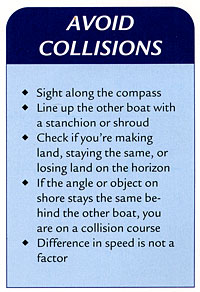
Rule 2: When you are on opposite tacks, the starboard tack boat has the right-of-way.
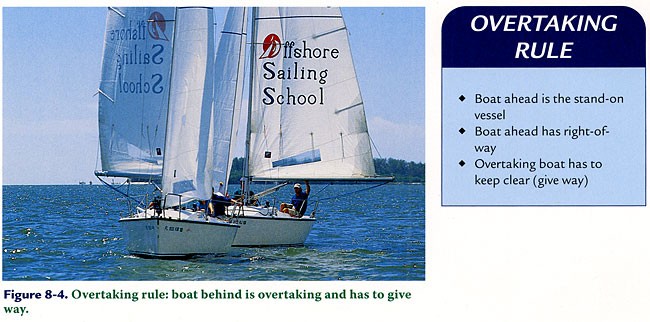
Rule 3: If you are overtaking the other boat, or it is overtaking you, the boat ahead (the overtaken boat) has the right-of-way.
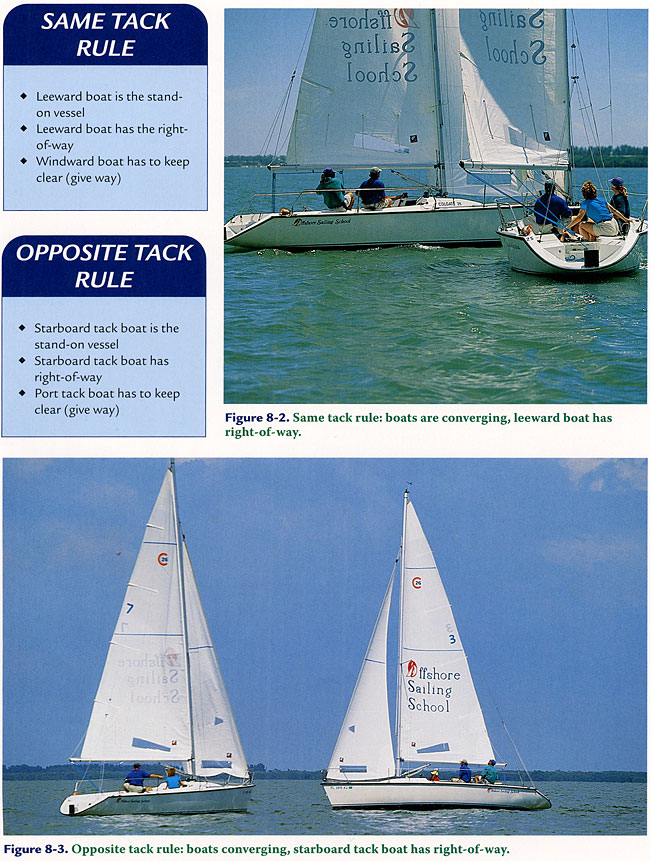 In Figure 8-2, two boats are approaching each other and subject to the same tack rule. Sailors refer to the boat with right-of-way as the stand-on vessel-the boat that must hold its course. The leeward boat has right-of-way, and the windward boat has to keep clear, or give way. Which boat is the leeward boat? If you said the boat on the left, you were correct.
Figure 8-3 shows the opposite tack rule. The starboard tack boat is the stand-on vessel and has the boating right-of-way. The port tack boat has to keep clear or give way. Which boat is on port tack? If you said the boat on the right, you are correct.
Figure 8-4 shows two boats involved in the overtaking rule. In this case the boat ahead is the stand-on vessel and has the boating right-of-way. The overtaking boat has to keep clear or give way. Which boat is overtaking and what tack is that boat on? If you said the boat behind is overtaking and is on starboard tack, you are correct.
Note that these boats are sailing downwind, with the wind pushing from behind, and they are on opposite tacks. In the overtaking rule, the difference in tacks is not relevant, unless you are racing. Over many years, a complete set of sailing rules of the road specifically for sailboat racing has been developed and administered by the International Sailing Federation (ISAF), que ahora pasa Vela mundial, but these are not relevant to recreational sailing. Si usted está buscando convertirse en un marinero Pro, check out our Cursos de Certificación de vela en alta mar. Enseñamos seguridad en la navegación y cómo evitar colisiones en nuestro Básico Aprender a Navegar y Sin patrón de crucero cursos en ubicaciones turísticas en Costa del Golfo de la Florida y la Islas Vírgenes Británicas. Pruebe la navegación viendo este vídeo con felices estudiantes e instructores de Offshore Sailing School. Ver video. También elaboramos un curso online para aprender a navegar de 4 horas en colaboración con la Fundación BoatUS.. Hay una tarifa nominal. Obtén detalles.
Otros recursos sobre navegación y manejo seguro de veleros: Nuestros amigos de la Fundación BoatUS ofrecen esta útil guía de cursos de seguridad en la navegación en los EE. UU.. Ver guía. Similarmente, nuestros amigos con los EE.UU.. El Auxiliar de la Guardia Costera ofrece esto práctico esquema de reglas de tránsito.
Ver todos los cursos de Escuela de Vela en Alta Mar, incluyendo nuestra combinación más popular Fast Track a supuesto Cruising®.
Llamenos al 888-454-7015 o Contáctenos por correo electrónico para aprender más.