Saltar al contenido principal
Navegar en barco es un hermoso pasatiempo.. Es una actividad que te vincula con la naturaleza.. Debes aprovechar el viento para que el barco avance..
Aún, la dirección del viento es incontrolable, por eso debes aprender a dirigir el viento a tu favor. La relación entre el ángulo del viento y la velocidad y dirección del barco se llama puntos de vela..
Aprender los puntos de navegación es una habilidad importante para que cualquier navegante pueda maniobrar y controlar adecuadamente un velero..
La ciencia detrás de los puntos de navegación
Para navegar correctamente en un barco hay que entender la teoría detrás de todo.. Es imposible que un barco navegue directamente con el viento.. Si bien eso es obvio, es importante que realmente entiendas por qué.
Las velas tienen una forma triangular diseñada para desviar el viento., que impulsa el barco hacia adelante. Esto sólo sucede cuando el viento golpea la vela en ángulo.. Therefore, si el barco navega directamente contra el viento, el barco no se moverá.
Hay dos tipos: Viento verdadero y aparente
Probablemente hayas entendido el primer aspecto.: El viento que golpea las velas en ángulo puede hacer avanzar el barco..
Un aspecto secundario es entender que en el mundo de la vela existen dos tipos de viento.: viento verdadero y aparente.
viento verdadero Se mide desde un objeto que no se mueve.. Este es el informe de las estaciones meteorológicas de viento.
Viento aparente es el viento que siente un marinero cuando el barco esta en movimiento. Es una mezcla entre el viento real y la velocidad y dirección del barco..
Para una mejor comprensión, La siguiente tabla resalta las diferencias entre el viento aparente y el viento real.:
|
Término |
Definición | Impacto en la navegación |
Cómo varía |
| Viento verdadero |
La velocidad y dirección reales del viento medidas desde un objeto estacionario.. |
Utilizado como punto de referencia para la planificación y la navegación.. | Permanece constante a menos que cambien las condiciones climáticas.. |
| Viento aparente | El viento que siente un marinero en un barco en movimiento.. Es una combinación del viento real y la velocidad y dirección del barco.. | Afecta directamente al trimado de la vela., boat speed, y decisiones tácticas. |
Puede ser más rápido o más lento que el viento real dependiendo de la velocidad y dirección del barco.. La dirección también puede variar., especialmente cuando se navega en ángulo con el viento. |
¿Cómo se utiliza el viento aparente para navegar??
El viento aparente afecta los puntos de vela de la siguiente manera:
- Navegando contra el viento: Esto se refiere a navegar hacia un destino directamente en contra de la dirección del viento.. para compensar, navegas el barco lo más cerca posible del viento para avanzar en el ángulo más pequeño con respecto al viento aparente. Esto también se conoce como navegando en ceñida.
- Navegando a favor del viento: Esto se refiere a navegar en la misma dirección que el viento., lo que significa que la velocidad aparente del viento se reduce. Las velas generalmente se despliegan para capturar más viento y lograr velocidades más rápidas y mayor control..
El uso de puntos de vela
El uso adecuado de los puntos de vela le ayudará a hacer lo siguiente:
- Maniobras adecuadas: Si entiendes los puntos de navegación., puedes ajustar o 'guarnecido de vela'’ para maximizar la velocidad y eficiencia del barco.
- Navegación a barlovento y sotavento: Comprender los puntos de navegación te ayudará a evaluar si estás navegando más cerca del viento. (barlovento), o lejos del viento (sotavento).
- Seguridad: Podrás anticipar mejor los cambios en la dirección del viento y ajustarte adecuadamente para no perder el control de la dirección del barco..
¿Cuáles son los puntos de vela??
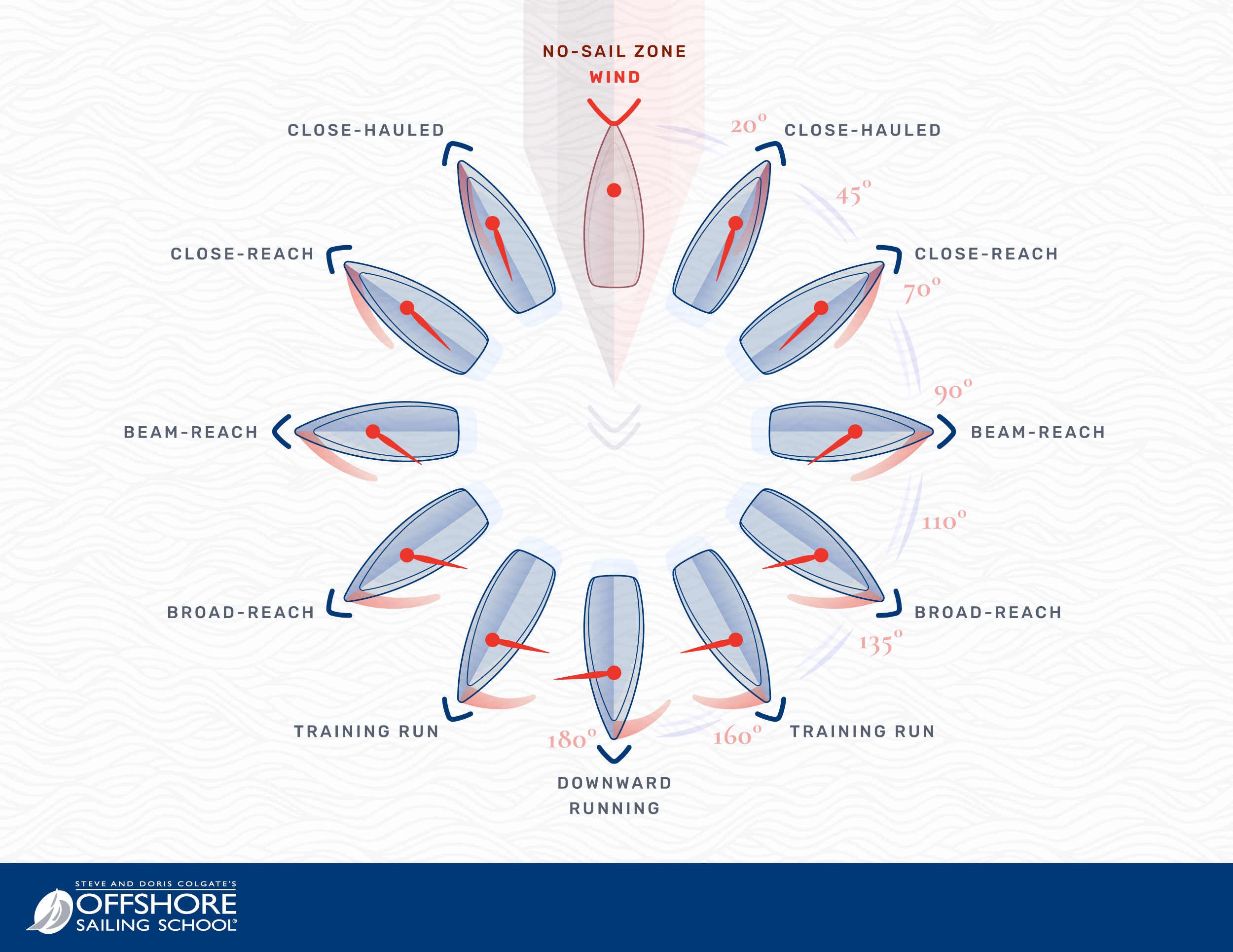
Para contexto, Es importante entender que un barco tiene dos lados.: una amura a babor y amurada a estribor.
- Amurada a estribor: Cuando el viento sopla del lado derecho del barco..
- Puerto gracias: Cuando el viento sopla del lado izquierdo del barco..
Los puntos de vela son las diferentes direcciones que puede viajar un velero en relación con el viento..
- Cerrada: Navegar lo más cerca posible del viento, generalmente en un ángulo de 30-45 grados.
- Alcance cercano: Navegando entre ceñida y alcance de manga, 60-70 grados fuera del viento.
- Alcance del haz: Navegar con el viento directamente en el costado del barco., o 90 grados.
- Amplio alcance: Navegando con el viento que viene de detrás del barco., aproximadamente en 120-160 grados desde la parte delantera del barco.
- Correr: Navegar con el viento directamente detrás del barco., convirtiéndolo en el punto de navegación más rápido.
Si bien la zona de prohibición de navegación no es un punto de navegación, está asociado con estos conceptos en la mayoría de los diagramas y la literatura..
La zona de prohibición de navegación
La zona de prohibición de navegación o ser “en hierros” Es cuando el velero no puede generar suficiente fuerza para avanzar.. Esto sucede cuando el viento golpea directamente la parte delantera del barco., haciendo que las velas se aquieten’ o aletean y pierden su forma e impulso.
Therefore, asegúrese de que la parte delantera de su barco nunca apunte hacia el viento.
Cerrada
Ceñida es el punto de vela más cercano al viento.. Ajusta bien tus velas para atrapar el viento.. Navegar en ceñida requiere que coloques tu velero en un ángulo de 30-45 grados relativos al viento.
Alcance cercano
Navegar de cerca te permite aflojar un poco más las velas..
A través de este punto de navegación, estás navegando en un ángulo ligeramente alejado del viento. Se considera eficiente y cómodo., porque eres capaz de trabajar con una combinación decente de velocidad y control con esfuerzos mínimos.
Alcance del haz
Con este punto de vela deberás soltar las velas hasta la mitad..
Con alcance de haz, estás navegando perpendicular a la dirección del viento, o una 90 ángulo de grado. El alcance de la manga se conoce como el punto óptimo del marinero porque el barco mantiene la estabilidad y produce una velocidad razonable con pocos o ningún ajuste..
Amplio alcance
Con este punto de vela podrás soltar aún más tus velas..
Durante el amplio punto de navegación, El viento sopla desde detrás del barco.. Aquí el viento llena las velas por detrás., empujando el barco hacia adelante. Experimentarás altas velocidades, por lo que se sugiere precaución para evitar que la embarcación pierda su estabilidad..
Correr
Aquí tus velas se sueltan tanto como sea posible..
Durante la carrera o 'a favor del viento'’ point of sail, el viento está directamente detrás del barco. Puedes alcanzar velocidades máximas, pero considere que en este punto el barco se encuentra en su mínimo grado de estabilidad., así que mantenga una distancia segura de otras embarcaciones.
¿Cómo cambio la dirección del barco??
Hemos mencionado varias veces que dependiendo del punto de navegación, Debes cambiar la dirección del barco para garantizar la navegación más eficiente..
En tu viaje para conquistar el conceptos básicos de navegación, aprenderás a virar y trasluchar, Las maniobras imprescindibles para cambiar el rumbo de tu barco..
- virar: Para cambiar de dirección contra el viento, giras la parte delantera del barco moviendo las velas hacia el lado opuesto para continuar el impulso hacia adelante.
- Jibing: También escrito como trasluchando, Usas esto para cambiar tu dirección con el viento.. La parte trasera del barco pasa a través del viento moviendo las velas hacia el lado opuesto..
Aprender estas maniobras te permitirá realizar una transición suave entre los puntos de vela., permitiéndole navegar por las aguas con facilidad.
¿Dónde puedo aprender los puntos de navegación??
En Marino Escuela de Vela Estamos orgullosos de ofrecer más de 60 años de experiencia en la docencia durante 160,000 estudiantes cómo navegar en las aguas.
Nuestro curso de certificación más popular, la Fast Track to Cruising® está diseñado para ayudarte a aprender a navegar en una semana sin experiencia previa. Dominar los puntos de navegación es solo una gota de nuevos conocimientos que obtendrás con nuestros expertos certificados..
No somos sólo el mejor curso de vela, somos la escuela de vela para la vida. Si está interesado en aprender cómo empezar, contacta con nuestro navegación certificada iInstructores para programar su primera consulta.!